The Hidden Costs of Traditional Soil Sampling
July 14, 2025
Note: this is a summary of the original post, condensed for this rebuild rather than reproduced word for word.
Every farming budget has a line item for soil testing — lab fees, shipping, sampling supplies. Those costs are easy to see. The bigger financial drag, though, tends to be invisible: the time a slow process costs you, the labor it consumes, and the inaccuracy baked into how traditional samples are collected in the first place.
The costs everyone sees
Lab fees scale with how much you test — a basic pH and macronutrient panel costs less than a full micronutrient and organic-matter workup, and either way, testing enough points on a large field adds up fast. Add shipping (often expedited, to protect sample integrity over long distances to a lab) and the recurring cost of probes, sample bags, and GPS gear for marking sample locations. All real costs — and still only part of the picture.
The cost of waiting
Lab turnaround can run several weeks, which forces fertilization decisions to be made on stale data. Apply nutrients too early against that lag and you risk leaching and runoff; apply too late and the crop misses its critical growth window. Either way, a slow feedback loop quietly converts into lost yield.
The cost of the labor itself
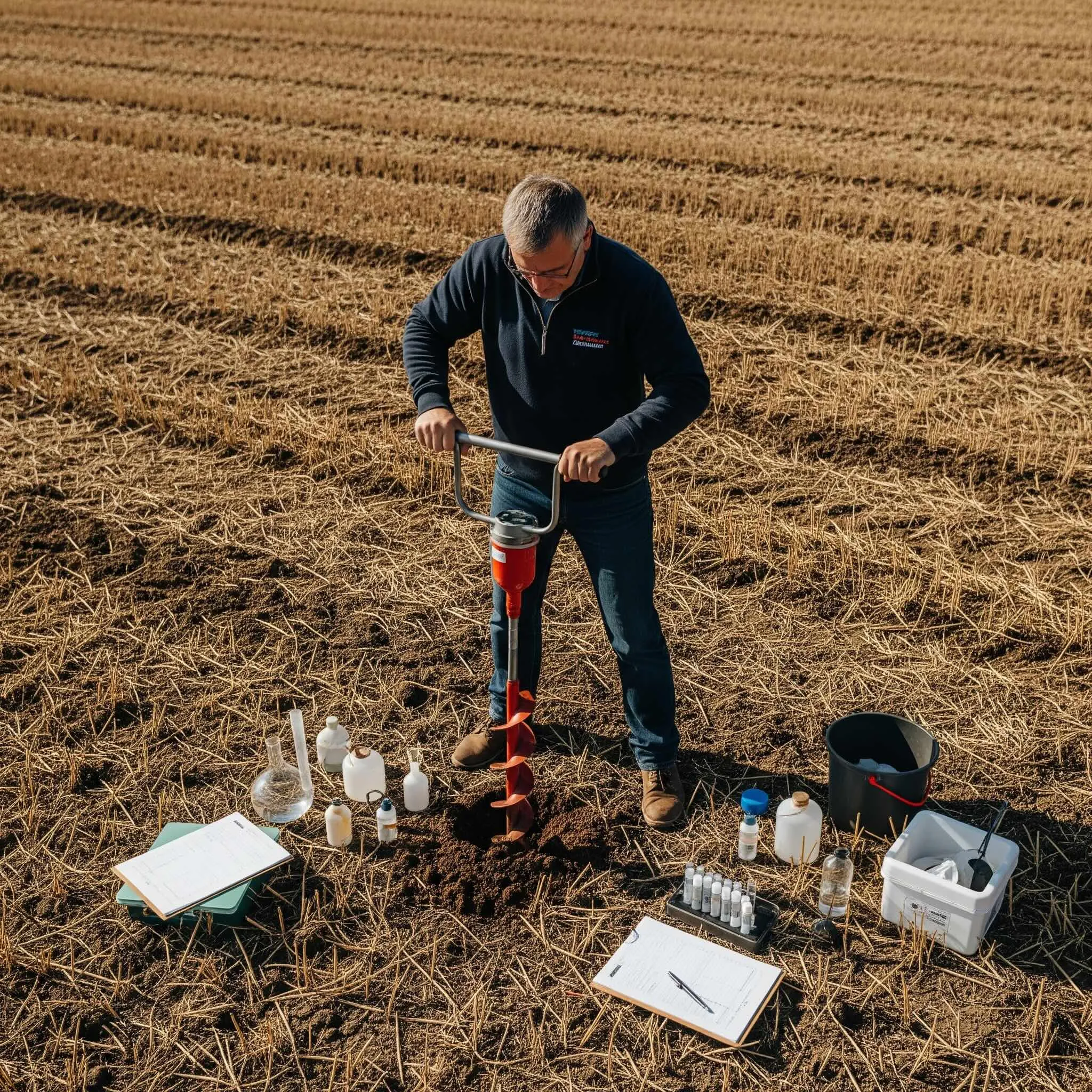
Grid sampling is physically demanding: someone has to walk the field and collect samples against a pre-defined grid, burning hours, fuel, and vehicle wear in the process. That's time an agronomist or farmhand isn't spending on higher-value work — reading yield data, scouting for pests, or refining management strategy.
The cost of getting it wrong
The most damaging hidden cost may be accuracy itself. Composite sampling averages several cores from a wide area into one number, which smooths right over the real nutrient variability inside a single field. That average then drives a flat-rate application that's almost guaranteed to be wrong somewhere: over-fertilizing zones that were already fine (wasting input and risking runoff), and under-fertilizing deficient pockets (capping yield where it mattered most). The root problem isn't the lab work — it's that the underlying data was never granular enough to represent the field's actual condition.
A different way to collect the data
The real fix isn't a faster lab — it's a different way of collecting the data in the first place. Instant, field-wide, remote soil analysis removes the weeks-long wait, the manual grid walk, and the averaging problem all at once, replacing them with a value for every patch of the field rather than one number for the whole thing.
See how Siora's satellite soil analysis works, oranalyze your first field.